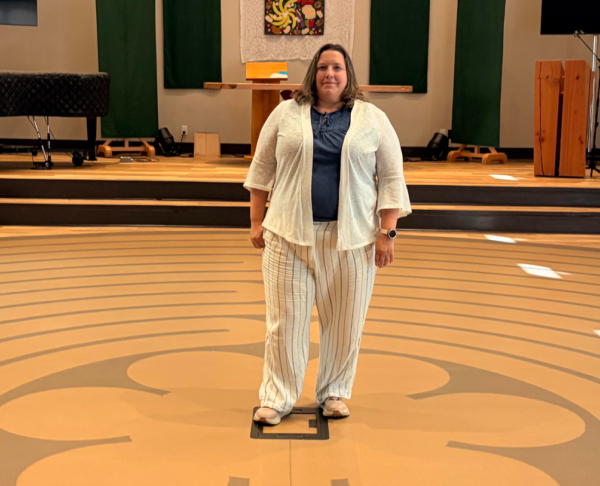






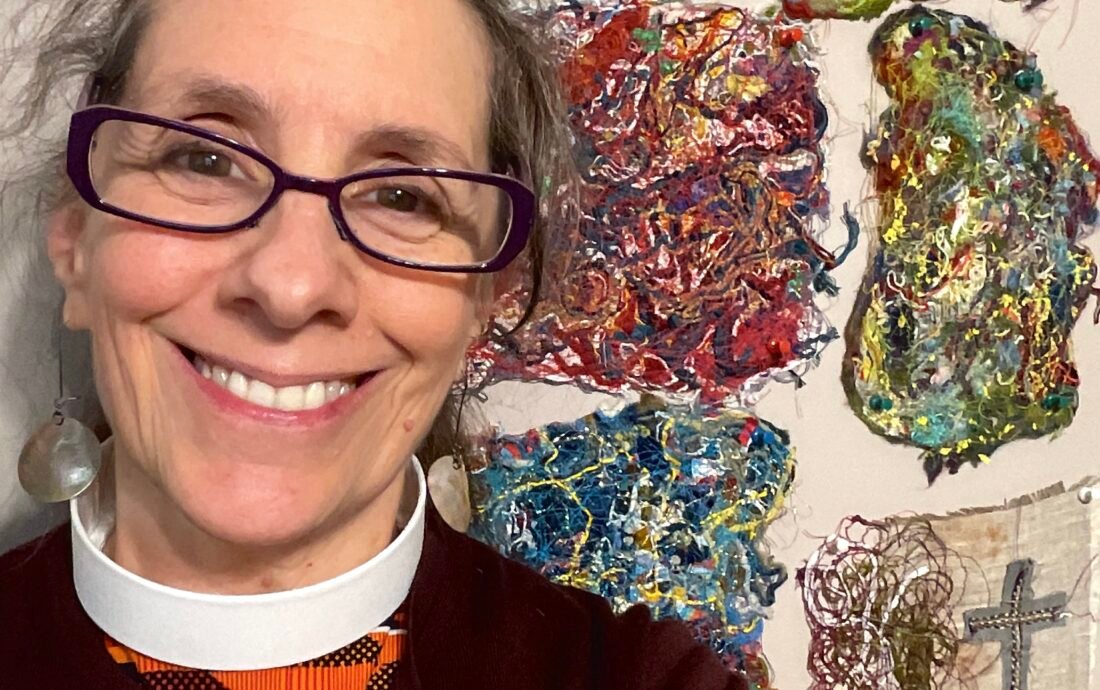
For Jenn Ashton, the path to ordination meant sorting through feelings that, in her words, were “all very tangled.” Ashton, a Sḵwx̱wú7mesh author and artist from North Vancouver, is the first Indigenous deacon in the Anglican Diocese of New Westminster. She serves as a deacon and Indigenous Ministry Leader at St. Clement’s Anglican Church in Lynn Valley.
She explores that experience in Tangle: A Road to Reconciliation, a personal art project being shared through St. Clement’s ahead of the National Day for Truth and Reconciliation. Ashton created the work during her postulancy at St. James Anglican Church, as she discerned ordination to the vocational diaconate.

“It is meant to represent the journey I went through as I tried to piece together my feelings as I traversed the spaces between ordained life and my Indigenous, Intergenerational Survivor life,” Ashton told North Shore Local. She said she hopes viewers will understand both her own process and the wider process of discernment.
The title, she said, reflects how that time felt. “During my internship at one of Vancouver’s earliest churches, it was a challenge to sort out my feelings, and there were so many to sort out; it was all very tangled.”
One image in the work carries particular meaning for her. “I think the image that stands out for me is the footprint photo, because it really was one step at a time, being in the moment, whether that moment was painful or joyful; all the steps were necessary,” she said.

The idea grew out of conversations with Mother Amanda Ruston, Ashton’s priest at St. James, who kept suggesting an art project for her internship. Ashton said she set the idea aside at first. “I pushed it out of my mind because I had no idea what I could do that would encompass what I wanted to say, and then, seemingly out of the blue (or guided by the Spirit!), the idea came to me.”
Asked what it means to serve as an Indigenous person in a church that was involved in the residential school system, Ashton said she asks herself that daily. “This is a question I ask myself every day because there is no single answer. It is an evolution of feelings,” she said.
Ashton is an Intergenerational Survivor. Her ancestor, Granny Annie, was among the first to be taken to St. Mary’s Residential School. Ashton said she tries “very hard to keep understanding the past while remaining focused on the future, and how the church can participate in neighbourhood relationship building.”
The same question shapes her doctoral research. “In my doctoral research right now, I am very focused on separating the people and systems, God and justice, and looking deeply into the mechanics of colonization,” she said. She added that her answer is still taking shape. “Ask me this again in a year, and I may have a better answer!”
Ashton described Tangle as a personal project. Asked whether the Squamish Nation or Tsleil-Waututh Nation were consulted, she said, “Tangle is a personal project that only included me and my experiences.” She said no other Indigenous Elders, artists, knowledge keepers or organizations were consulted, “as there was no need.”
She hopes viewers come away with an understanding, or at least an appreciation, of what it takes to reconcile “with ourselves, with the Creator and with others.” Ashton said reconciliation is an individual process because each person experienced colonization differently. “I hope this further reveals that there is no one-size-fits-all road to Reconciliation, and that people need time and space to work through it in their own ways.”
The project is open to anyone, not only the St. Clement’s congregation. Ashton said anyone who can view the website is welcome to take part, and people can contact her for more information or to discuss the work.