





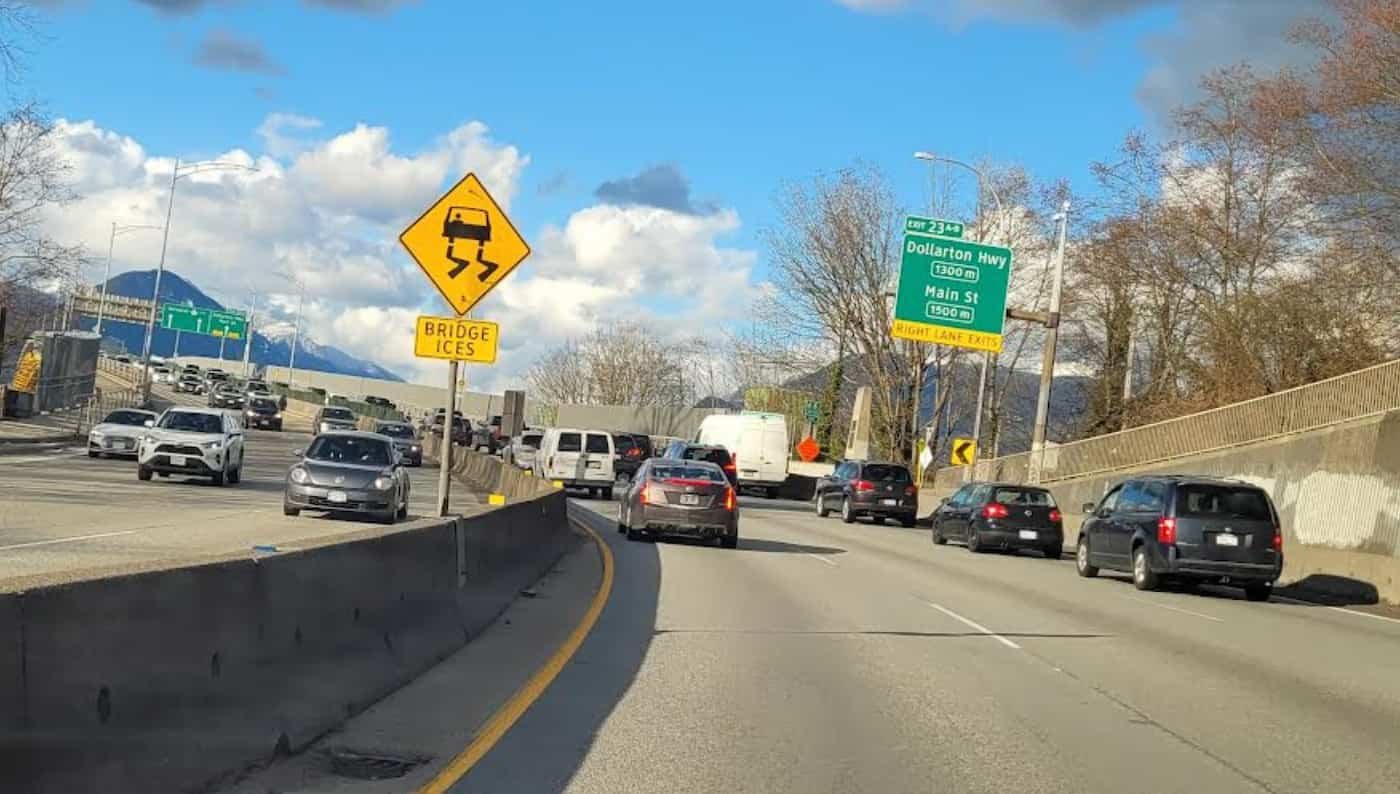
Eastbound traffic jams on Highway 1 now stretch from around midday into the evening, pushing more drivers onto North Vancouver streets and disrupting bus service near schools, according to a City of North Vancouver report.

On East Keith Road, the effects can go beyond a late bus. The report says afternoon congestion “can result in bus detours and passengers being left at stops.”
Reach local customers on the North Shore. Advertise with us.
City staff compared traffic conditions in 2019 and 2025 for a Transportation Network Plan update scheduled for presentation to council on Nov. 23. They combined traffic counts from the Ironworkers Memorial Bridge with estimates from StreetLight, which uses samples from connected devices calibrated against traffic counts to show broader travel patterns.
The Nov. 18 report identifies four findings. Highway 1 is an important route for travel within the North Shore; traffic volumes have grown, eastbound congestion has become more frequent, and the effects are increasingly felt on municipal streets.

What the city found about Highway 1 traffic
Nearly a third of eastbound trips stay on the North Shore
Staff estimate that 32 percent of eastbound Highway 1 trips stayed on the North Shore, based on data from May and October 2025.
A separate analysis, using data from January through April 2022, found that about 75 percent of weekday vehicle trips ending in the City of North Vancouver started elsewhere on the North Shore. Together, the findings show how closely the highway and local streets are tied together for trips within the region.
Bridge traffic grew faster on weekends
Two-way traffic volumes on the Ironworkers Memorial Bridge rose by 3.8 percent on weekdays and 9.9 percent on weekends between 2019 and 2025. Staff attribute the smaller weekday increase to increasingly congested conditions during peak periods.
Eastbound backups last longer, and fewer vehicles get through at peak times
Eastbound congestion now extends over a longer part of the day than it did in 2019, starting around midday and continuing into the evening. Between Lonsdale Avenue and Mountain Highway, the city’s analysis found congestion occurred more often and traffic moved more slowly during backups.

Traffic volumes were lower during parts of the afternoon peak. The report explains that “more frequent congestion reduces highway throughput,” leaving fewer vehicles able to get through the most constrained stretch. Comparing congested and uncongested days in 2025, staff also found that many drivers appeared to shift their trips to later in the evening.
Conditions improve farther east toward Main Street, which staff link to improvements at the Lower Lynn Interchange.
Highway backups are affecting buses and streets near schools
When eastbound Highway 1 backs up, some drivers leave the highway earlier or use city streets to bypass congested sections. The analysis found corresponding traffic increases on East Keith Road, East 17th Street, East 23rd Street and East 29th Street, as well as on some smaller neighbourhood streets.
Staff flagged two areas for particular attention. One is around Boulevard Crescent and Grand Boulevard, near Sutherland Secondary and Queensbury Elementary. The other is along East Keith Road near Cloverley Elementary.
Reach local customers on the North Shore. Advertise with us.
In those areas, more traffic and longer queues make it harder to get in and out of neighbourhoods and create more difficult conditions for people walking or cycling, particularly near schools. The two hotspots also contribute to delays and unreliable service on bus routes 240, 232 and 255.
CNV identifies two possible projects for 2027 capital budget
Staff have put forward two projects to improve capacity on major city roads for consideration in the 2027 capital budget. The broader transportation plan will consider changes to how those roads operate, where buses could get priority and whether local trips can be better separated from traffic heading for the Ironworkers Memorial Bridge.
Staff say the aim is to improve the network’s “capacity, reliability and resilience” for moving people and goods. That means looking at how a change on one street would affect other routes and how limited road space can serve drivers, transit riders, pedestrians, cyclists and deliveries.
The vehicle analysis is the first part of the city’s assessment. Staff are also examining walking, cycling, transit and goods movement. Public engagement is expected to begin in spring 2027, with an early draft of the Transportation Network Plan anticipated that summer.