





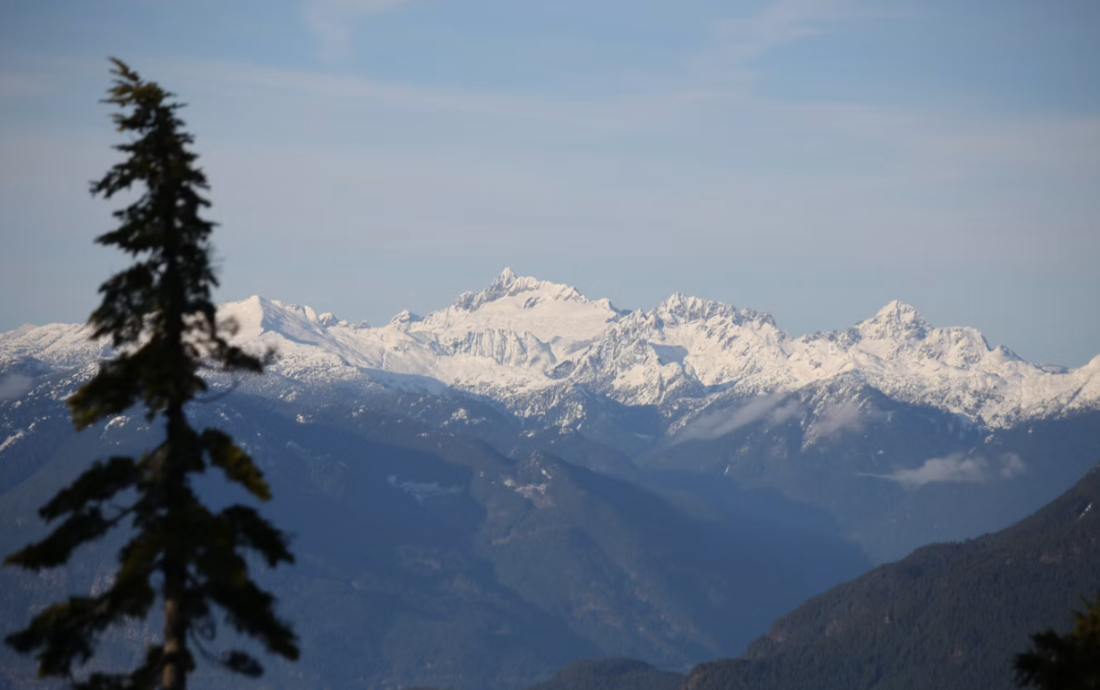
The North Shore mountains form the backdrop to nearly every photograph taken on this side of the inlet, whether from the Lions Gate Bridge, a kitchen window in Lynn Valley or the deck of a SeaBus pulling into Lonsdale Quay. After enough years, they can stop registering as anything more than the view.
But the view is hiding something. A few hundred metres up those slopes, in pockets the loggers could not reach, and developers could not build on, stand trees that were already old when Vancouver was still a sawmill town. Some were old long before that.
The North Shore is one of the few places where you can leave a busy shopping district and, within an hour, stand beneath a tree that began growing during the Tang Dynasty. That is not an exaggeration. That is Cypress.
How any of it survived
The honest answer is that much of it survived by accident.
A century of industrial logging worked its way across these slopes and removed nearly everything within reach. Much of what remains survived because it was too steep, too rocky or protected for reasons that had little to do with preserving trees.
The Capilano and Seymour watersheds retained their old growth not because people in 1900 were thinking about biodiversity, but because Vancouver needed clean drinking water and forests made effective natural filters.
Lighthouse Park was set aside in 1874 partly so the keepers at Point Atkinson would have a dark backdrop against which ships could see the lighthouse beam. Nobody was trying to protect a Douglas fir. The lighthouse simply needed to work.
Those practical decisions helped preserve some of the last remaining low-elevation old-growth forest in the region. The trees got lucky. The North Shore became the beneficiary of that luck.
What old growth actually means
Age is only part of the story. What makes an old-growth forest an old-growth forest is its structure. Layers, gaps, and apparent disorder take centuries to develop and can disappear in an afternoon. Coastal rainforests do not usually renew themselves through large fires in the way many Interior forests do. Change often comes one tree at a time.
A veteran tree, perhaps 60 metres tall, eventually loses its battle with wind, disease or age and falls. The opening it leaves in the canopy floods the forest floor with light, sometimes for the first time in centuries. Plants and young trees that had been waiting in the shade begin to grow.
The fallen tree also becomes some of the most valuable real estate in the forest. The forest floor can be a difficult place for a seedling. Heavy competition, deep moss, and limited light make it hard. A decaying log, raised above the ground and holding moisture like a sponge, offers better odds.
Generations of hemlocks and cedars begin life on the remains of older trees. The forest feeds itself and slowly grows back.
Hikers can see the evidence along the Lower Seymour Conservation Reserve’s Old Growth Trail, where trees sometimes appear in an unusually straight row. They may have taken root on a nurse log that decayed centuries ago. The log has disappeared, but the lineup remains.
The forest has been managed for centuries
There is a tendency to describe old growth as untouched, a pristine landscape that existed before people. It was not.
Coast Salish peoples lived with and managed these forests for thousands of years before today’s boundaries and property lines existed. Evidence of that relationship still exists across the North Shore.
People who know what to look for may recognize Culturally Modified Trees, including Western redcedars bearing long vertical scars where bark was carefully harvested for weaving. Other trees contain test holes made to assess the quality of the wood before deciding whether to fell it.
Many of those trees survived and continue to grow. A cedar stripped for bark three centuries ago is both a living organism and a record of the people who used and cared for the forest. As an example of sustainable forest use, the fact that the tree is still standing centuries later says plenty.
Building old growth on purpose
Forests logged a century ago will not become old growth again anytime soon. They may eventually get there, but ecological time is measured in centuries, not human lifetimes. Researchers are now looking for ways to speed up that process.
One technique is known as restoration thinning. Second-growth forests, those that returned after clear-cut logging, often grow back dense and uniform. Most of the trees are the same age and roughly the same size, competing for the same light and nutrients.
If left alone, the forest will gradually sort itself out. Some trees will grow larger, others will die, gaps will form, and the stand will become more varied. But that process takes a very long time.
Selectively removing some trees from an overcrowded stand can imitate the opening created when a large tree falls. More light reaches the forest floor, while the remaining trees gain room to grow wider and develop more complex crowns. Coastal experiments have found that thinning can significantly increase the growth of the trees left behind and help younger forests develop some old-growth characteristics sooner.
It is not a shortcut to old growth, but it can help a damaged forest move in the right direction.