




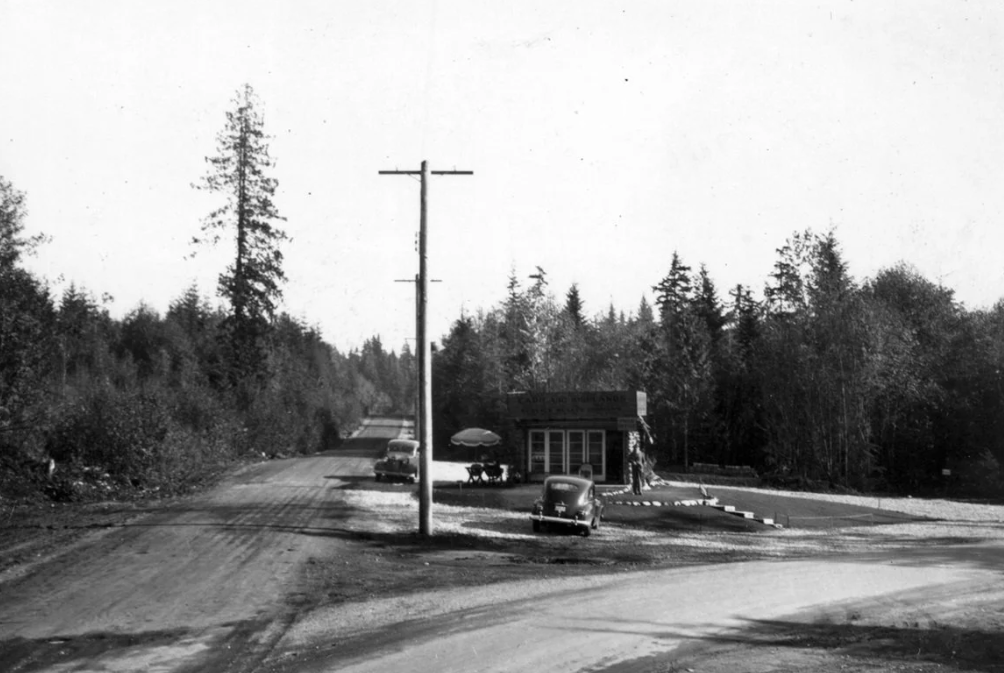
Edgemont Village began with a housing crisis, not today’s, but the one that followed the Second World War, when land on the North Shore was so plentiful that lots sold for under $1,000. In the late 1940s, RCAF veteran John Eric Allan opened Capilano Highlands from a log cabin field office at Ridgewood and Edgemont, partnering with architect Fred Thornton Hollingsworth to build affordable West Coast Modern homes for middle-class families.
The Dendrochron sculpture at that same corner today depicts the rings of an ancient forest giant, a nod to what the land was before: mile upon mile of fir, hemlock, and cedar.
The village grew without a master plan. Streets followed the contours of the sloping land rather than Vancouver’s grid. Businesses opened before sewers and roads were finished in 1956. The eclectic mix of rooflines, materials and building heights became Edgemont’s character rather than a flaw to correct. Many of those original single-storey wood-frame buildings still stand, and they remain the right size for the small independent businesses — roughly 80 percent of them women-owned — that have defined the village for decades.
The continuity is remarkable when you start naming it. The barber shop on Edgemont has been family-run since 1960, the oldest in North Vancouver. Highland Optical, owned by longtime resident Sharyn Webber, has been there since 1964. 32 Books has been on Connaught for over 20 years under Deb McVitie. Edgemont Gourmet Meats, Delany’s coffee shop, the Capilano library branch that opened in 1964. These aren’t relics; they’re the place’s working fabric.
That fabric is now under strain. The Columbus Market closed in December after 30 years, its owner citing rising rents and costs. The village post office and stationery shop shut at the end of January. The last service station, a Chevron at the village centre, is slated to close, with a development application before the District for a four-storey mixed-use building with underground parking — a scale that would require an OCP amendment and rezoning on a block of mostly one- and two-storey originals.
Webber, writing to the North Shore News in 2016, called the surrounding construction boom a “tsunami of development.” The District’s own 2024 OCP white paper acknowledges that independent businesses are finding it increasingly difficult to survive, and that neighbourhood vibrancy depends on them.
Edgemont was never a mall. The question is whether it can stay that way.